How Do I Increase My Metabolism?
Metabolism is complicated and misunderstood. Most of it's impact on energy balance is outside of your control. The elements under your control are mostly exercising, eating and maybe improving body composition. But increasing eating obviously increases energy intake, and that just goes to show you that universally trying to increase metabolism might not move you towards your goal(s).
STOP WORRYING ABOUT IT.
Start worrying more about how you can productively work towards your goal(s). If you're really, really concerned that you have a metabolic condition lowering your metabolism, see a doctor to confirm. It won't mean you can't lose weight in any case; it just means you have to approach it differently.
If a buzzword could finish second to ‘toned’ in the weight loss industry, ‘Metabolism’ would be right up there. ‘The Fast Metabolism Diet…’ ‘The Metabolism Boosting Diet…’ ‘The Metabolism Miracle…’ ‘Jillian Michaels: Banish Fat, Boost Metabolism…’
No, that last one isn’t a joke, it's a book that actually exists…
The thing is, how do you know if your metabolism is slow? Is it slow, or just lower than expected?
What most diet gurus fail to mention in their metabolism-boosting secret workouts is that metabolism is an excruciatingly complex topic, and anyone who claims to know the ins and outs of everything metabolism is mostly full of shit.
Here is a tiny fraction of the chemical processes that add up to metabolism in the human body:
- Cellular Respiration
- Breathing
- Exercise (purposeful muscle contraction, movement)
- Non-Exercise Activity Thermogenesis (NEAT)
- Eating (Digestion, mastication)
- Glycogen-Glucose Breakdown/Storage
- Fat-Fatty Acid Breakdown/Storage
- Protein-Amino Acid Breakdown/Storage
- Regeneration of Skin
- Regeneration of damaged cells in all of your organs (including bone, liver, lungs, GI tract, etc.)
- Thinking
- Stress (which just means a stimulus placed upon the body that requires a reaction)
- Filtration via the Kidneys
- Detoxification via the Liver
- Blood Circulation
And that’s just getting started…
Check out a metabolic wiki page that only scratches the surface on what some physiology textbooks discuss, and tell me your mind isn’t blown.
OK, hopefully you get it by now. This is a complex topic, and like most complicated subjects, a lot of people get confused when the topic comes up.
To understand how you can boost it, you must first clarify what it actually is, what it isn’t, and why it even matters.
Metabolism is the sum of all the reactions that take place within the body to build it up and break it down.
Pretty easy to define,, right? It’s a little harder to fully understand…
This includes all the things on the above list and the billions (maybe trillions) of other chemical reactions that take place in your body every day.
Where it gets confusing is that most people confuse metabolism with basal metabolism, AKA resting metabolism. Or more specifically, your basal metabolic rate (BMR), AKA resting metabolic rate (RMR).
What is Basal (or Resting) Metabolism?
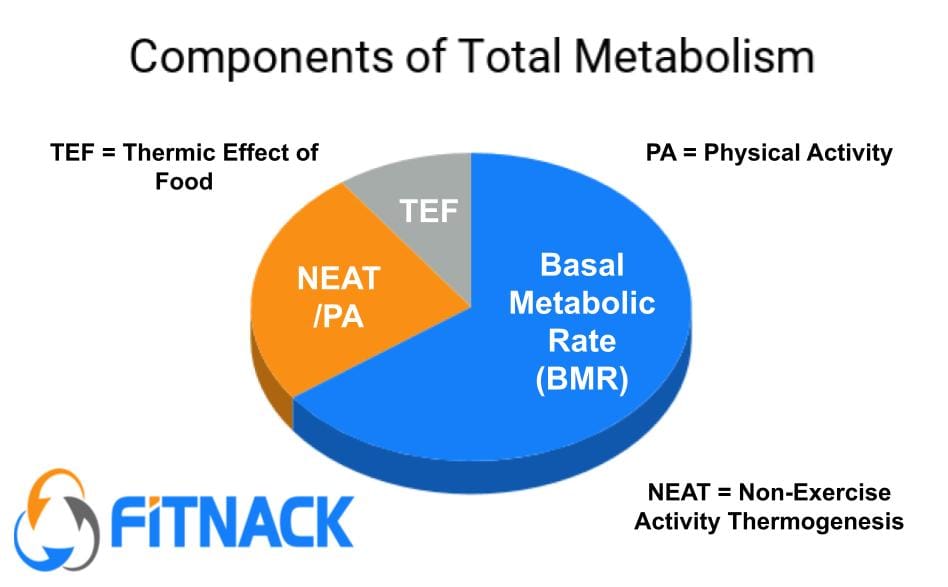
Not to be confused with the term metabolism, which also includes all your non-exercise activity, your exercise activity, and the metabolic cost of eating/digesting food.
Basal metabolism is the minimum level of energy expenditure the body needs in order to maintain the vital functions within the body.
Unless you’ve had a basal metabolic assessment, which utilizes oxygen exchange to discern your RMR by breathing into a tube for a period of time while you're completely still and usually lying down, you probably don’t actually know whether your metabolism is fast or slow compared to average. Again, technically speaking, it's higher than expected or lower than expected because energy tends to be measured using kilocalories (a measure of heat, technically) or kilojoules.
If you lived a completely sedentary life, didn’t eat and stayed at a constant temperature, your BMR and your complete metabolism would be pretty darn close in terms of energy expenditure. But nobody does that, because you can't and survive.
Basal metabolism is the biggest chunk of total metabolism in an average day, at about 70% (±10%?) of your total metabolism, and is mostly beyond your control on a day-to-day basis.
A variety of hormones work in tandem to modulate this, and it can fluctuate depending primarily on energy balance. If you keep energy balance about the same on average, then the fluctuations are relatively minimal or minor.
Now, when energy balance fluctuates to a significant degree over a period of about 3-5 days (at a minimum, from memory), there are elements of the basal metabolism that adjust to account for this imbalance. In a surplus, without a stimulus to shuttle that surplus of energy to muscle growth, your body will store the excess as fat. This actually has a small metabolic cost, but the body may also look for ways to utilize energy it has available, depending on how lean you are and how much fat you already store.
The possible mechanisms for driving basal metabolism up to adjust or find balance in periods of excess just aren't very strong, which is why it's so easy to gain fat. That's a survival mechanism too; long ago, we had to deal with periods of excess that offset potential periods of starvation. It makes a great deal of physiological sense to store excess energy in periods of food prosperity.
However, the effects of energy deficits have a much stronger moderating effect on metabolism to find balance and prevent starvation. Namely, the NEAT element (non-exercise thermogenesis, which can amount to a lot of metabolism in non-exercising humans), so unconsciously, people just start moving less and become lethargic. However, there are elements to the whole basal metabolism that also start conserving energy and lowering basal metabolism, which in turn lowers total metabolism.
The larger the energy deficit, the faster the lowering effects on metabolism are seen. But the double whammy is also the duration. The longer and higher a deficit is, the larger the effect is. The smaller the deficit, might lead to much less of an adaptive response, so you can maintain the deficit longer with less detrimental side effects, but they eventually all end up in the same place. I'm not saying large deficits are bad or long periods of calorie restriction are bad; it depends, but elements of your metabolism will eventually fight back on long-duration energy deficits averaged out.
You’re generally not going to be able to change your basal metabolism in a day, but it is also constantly in flux. Significant changes tend to need a minimum of about 3-5 days for the effects to be seen, so don't worry, you didn't destroy your metabolism because you had a bad day or did "too much" exercise or whatever other nonsense you've probably heard. Depending on the literature you're looking at, and the proxy or measure they use to associate with it.
Increasing Muscle Mass
We've all heard things like adding muscle to your body increases your metabolism; and it does, but the mechanism is through your BMR, because lean tissues are more metabolically active than non-lean tissues like fat.
Muscle mass and other tissues contribute more to basal metabolism than fat mass does, but the effects of adding a lot of muscle are somewhat overblown. Muscle makes up like 40% of average weight in a human, but only contributes about 25% to BMR. The lion's share of energy expenditure comes from the organs, especially the brain, and a little bit of it has to do with fat tissue.
Fat is not particularly metabolically active, so carrying more lean tissue (like muscle) is better, but contrary to what you may have heard about a pound of muscle burning an extra 30-50 kcal, the last time I looked at the literature, it was closer to 10-15 kcal per kg or anywhere between 5-8 kcal per pound per day (cardiac muscle burns more than skeletal muscle and a few other differences).
Meaning adding 10 lbs of lean mass would burn a whopping 70-80 kcal per day. It's not nothing, and it technically would lead to a faster (technically "higher") basal metabolism, but 1 tbsp of olive oil is ~120 kcal. Do you think adding 10 lbs is going to have the same effect as watching what you eat? Even a little bit? Yeah, probably not ...
Now this doesn’t seem like a lot, but assuming you don’t change the amount of energy you take in; If you add it up over the course of a year, suddenly you’ve lost about 3500 calories — the amount typically quantified as a pound of fat, which is also only really a partial truth — doing nothing but being ‘your-bad-self’ with a kilogram more of lean mass. Add 10 and maybe that 10 extra pounds over a year.
The reality is that it won't happen because of other factors in the system I already mentioned that adjust to find equilibrium, but it's a nice thought.
Again, it's not nothing, and I often help a lot of people gain about that much muscle, and it does help people stave off weight gain, but probably for other reasons than it "boosts their (basal) metabolism" to any meaningful degree. If I had to guess, it's the habit of exercise that helps them better modulate food intake with less deliberate oversight or intervention.
Yes, increasing mass increases metabolism, but bigger people have larger basal metabolisms almost regardless of the composition (bigger organs, more overall tissue to manage). Which is kind of ironic in a way, given how worried people can be about their metabolism dropping when they lose fat. Duh, it's supposed to! That's what being a smaller person does.
The point being, exercise by itself increases total metabolism or overall metabolism, so it's redundant as a term to include in any book title about exercise. There is no escaping an increased metabolism if you exercise; this applies to any kind of exercise, for any duration, and it's a spectrum of impact based on modality, intensity and duration.
And if the goal of these books is to increase metabolism without exercise, I've got bad news for you: you're going to have to keep the exercise up because dropping it will instantly drop your total metabolism too.
The effects of exercise on basal metabolism are relatively minor in comparison to the contributions that exercise can have. If you want to increase metabolism, all you have to do is start exercising a bit more than you previously did.
Exercise Metabolism
The first thing most people consider when the topic of metabolism comes up is exercise, which is an easy way to increase it, true.
However, like most things, it isn’t really that simple. Now that you understand the difference between RMR and metabolism, let’s talk exercise.
Remember that adding muscle does boost your basal metabolism a bit, but it doesn't stick around without a continued stimulus.
If you’re going to exercise, and I recommend that you do — in combination with some dietary changes, see below — you want to add exercise that gives you a spectrum of metabolically boosting effects, but the most important one will be preserving lean tissues via resistance training.
If you lift weights, over time you’ll add some muscle, boosting your resting metabolism, and everybody can go home happy. Just don't expect a ton of fat (weight) loss just because you started lifting. This can be seen in some large males from time to time, but it's unlikely to lead to big changes in energy balance.
So it's not just about lifting or muscle. Adding tensile strength by occassionally doing plyometrics or lifting in a heavier 3-6 rep range can promote other lean tissue growth or maintenance to the bones and tendons. These are also lean, metabolically active tissues, even if the effect on metabolism will be less than adding muscle.
However, energy system training shouldn’t be ignored either; just because it doesn’t have as big an impact on basal metabolism, it doesn’t mean it isn’t useful. It will contribute significantly more to total metabolism than lifting ever could, although I rarely tell anyone to concern themselves with the amount it burns because that tends to lead to these weird mental compensation patterns. Just do some: 3x3o minutes a week of a non-weight-bearing activity is a decent starting point, even in an energy deficit created with food.
Again, I think you should care too much about the energy burn part of the equation, but it improves health markers, maintains fat oxidation metabolic pathways and obviously, if you're that worried about metabolism, cardiovascular aerobic low intensity exercise can contribute significantly to that overall number.
Higher intensity interval training burns more energy per unit of time invested, but it also comes with higher recovery costs, so you have to balance it in the context of energy balance. It's not a good idea to do much (if any) in big energy deficits; it will also make you feel awful (speaking from personal experience). But at maintenance, mixing it in twice a week should work just fine as a slightly better use of time and contribution to total metabolism.
 Darren Beattie
Your daily activity (including exercise and other additional movements in the day) contributes anywhere from 15-30% of total daily metabolism, depending on how active you are, and again, it is a separate issue from resting metabolism.
Eating Metabolism
I’ll give you Cliff Notes on all those books above. If you really want to boost your metabolism, all you have to do is just eat more and exercise more, and BOOM! Done!
Problem solved, I have answered the riddle of fitness metabolism.
However, most of those books will tell you to eat less. Maybe the goal shouldn't be worrying about metabolism in the first place? 🤔
Not exactly, I’m assuming that if you’re here, you probably have a weight loss ambition, and most of those books probably assume that too, and like I said before, decreasing your size will lower metabolism. That's okay. It matters a lot less than these people would make you believe.
Eating more and exercising more doesn’t affect the amount of energy your body needs for its vital functions or its resting metabolism, just your total metabolism.
Eating can have a significant effect on your total metabolism, with the act of digestion contributing about 10% of your total metabolism each day.
Where things can get sticky is that while eating increases your metabolism, it doesn’t matter how often you eat, contrary to popular opinion.
There has been a myth floating around the internetz for nearly a decade that suggests eating more frequently will boost your metabolism.
Unfortunately, the theory never really held up because increasing your metabolism via food occurs due to the thermic effect of food (TEF), and TEF remains the same no matter how frequently you eat, provided the actual type (macronutrients) and total quantity of food you consume is the same that day.
Your overall macronutrient ratios are what’s important — though it’s not entirely that simple, there is variance in contribution between different types of protein, different types of fat and different types of carbohydrates; the easiest to explain is the difference between sugar and starch, obviously sugar is more easily digested,, even though both are carbohydrates.
If you have one large 2000-calorie meal or 4 smaller 500-calorie meals, as long as the total food consumed is the same, the result on your metabolism is identical. Your body responds to the total load over a larger time frame than just a day, larger meals digest slower and the effects amount to basically the same thing.
Even though the meal frequency thing is a myth, the basics of TEF can still be applied; you just need to do so by focusing on the quality of the food you consume, rather than the frequency.
Basically, your body has to use energy to break down food and absorb it.
- In the case of fat, your body uses roughly 3 kcal to digest about 100 kcal.
- For carbohydrates, it’s a little more, about 7 kcal for every 100 kcal you ingest.
- Protein, though, is through the roof, relatively speaking; it requires closer 25-30 kcal to digest every 100 kcal of this macronutrient.
Now, most research has some variance on those numbers, but just know that protein has the greatest TEF, carbs second, and fat last.
The more whole the source, the bigger the potential boost (whey digests faster than a steak, for example) although the benefits between those two food sources are stil relatively minor, it can't hurt.
Eating many things raw can also increase the TEF of that food, but that also doesn't mean raw is best, because the effect is likely minor in the big picture, and many foods should or will need to be cooked to unlock other nutrients — like potatoes, beets, squash, poultry, many cruciferous veggies, etc…
Whole grains require more energy to digest than refined grains (think whole grains vs white bread or something like that). Again, the effects are likely minor at each meal, but over the course of 3-4 meals a day, it might add up to something noteworthy.
If you want to boost your metabolism in a day, a simple suggestion would be to increase your protein consumption in place of some fat and carbohydrates — *I recommend a 3-4 oz protein source with every meal for women and a 6-8 oz protein source with every meal for men, of course, this depends on how frequently you eat though.
This will use up a little more energy each day, while you eat and thus ‘boost’ your metabolism, by displacing macronutrients and forcing your body to work a little harder to digest a certain type.
Eating itself also merely increases your metabolism for the day.
So Person A, who eats 6000 calories a day, has a higher total metabolism than Person B, who eats 3000 calories a day, even if their resting metabolisms are the same. Weird right?
Size and Temperature
Overall size also contributes to basal metabolism; the larger you are, the faster your basal metabolism typically is – outside of some very rare hormonal issues that impact basal metabolism like hypo or hyper thyroidism. I'm not talking about people with known pathological conditions here, though.
If you’re 260 and it’s mostly muscle, you’ll obviously have a faster metabolism than someone who is 260 and mostly fat.
However, chances are that if you’re 260 pounds of fat and someone else is 220, your metabolism is actually probably faster than theirs.
Hopefully, that makes you rethink the stigma surrounding the weight loss industry; That being overweight means you have a slower metabolism. Per unit of weight, perhaps, but your absolute or total metabolism will likely be higher.
Often it actually does not, so don’t let that notion stop you from adding some metabolic boosts to your day via quality nutrition and exercise; you can still make the changes anybody else can. You shouldn't fear a "slow metabolism," and that doesn't explain your struggle with weight either.
However, outside of getting a Basal Assessment — and if you have the financial means, consider it — some loose data is suggesting that body temperature can co-relate with your resting metabolic rate.
I don’t use this with my own clients, but if metabolism is a concern and you’d like to know if you’re impacting it, it might be a useful rough guide.
Try tracking your temperature every morning upon waking; a good resting metabolism should typically put you around 98.2 degrees Fahrenheit or 36.8 degrees Celsius at the start of the day. It has to be consistently taken at the same time of day to be useful, but I think there is the potential for a lot of noise in this data (which is why I don't really use it).
If you aren't consistent with the measures, circadian rhythm can influence this as it alters your body temperature to suit your sleep cycle, so if you’re on the low end, try tracking more throughout the day to see how your temperature fluctuates.
Typically, your body temperature will be at its peak at about 10-11 AM — depending on when you typically wake, but about 3-4 hours after waking — and then again around 7-8 PM — again depending upon when you typically go to bed, but about 3-4 hours before you go to sleep.
Body temperature is at its lowest roughly 2-3 hours before we wake, so your morning temperature might be lower than you expect. You may also see a dip in temperature after lunch from about 1-3 PM. Based on that, it might be worthwhile to check every 3-4 hours for a few days and gauge where your circadian rhythm is taking you.
*Note body temperature does not always correlate with basal metabolism in research, which is why I’d recommend a Basal Metabolic Assessment as a preference (far more accurate).
Or just forget about worrying about your basal metabolism because you don't have much control over it. Track weight, girth and appearance instead:
 Darren Beattie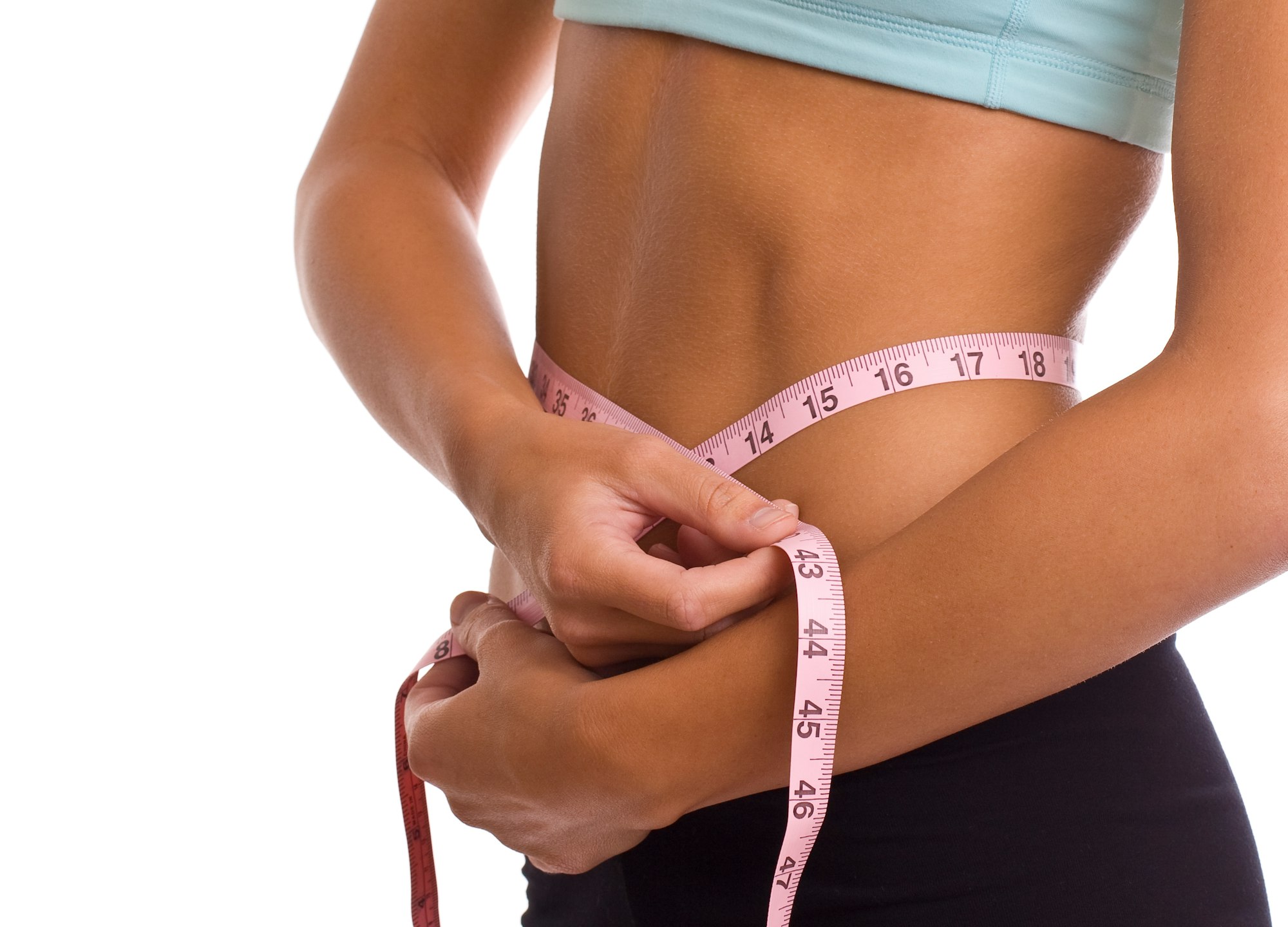
And modify how you eat and exercise so you're maintaining or progressing towards your goal. Stop obsessing over metabolism!
Metabolism So…
I know this may come as a big surprise to people, but the main factors that contribute to metabolism within our daily control are eating and exercise.
If you want to "boost your metabolism," do more of those things. It's not hard.
Yes, there are more specifics we know of, such as thyroid hormone and it’s involvement in the regulation of metabolism — and other mechanisms, but without medical testing, it’s nearly impossible to know what specifically could be affecting you.
Don't assume you have some medical pathology just because you struggle to lose weight. Lots of people do! In premise, it's easy; in practice, it's hard! And there are dozens of other combinations of factors leading towards that that have nothing to do with metabolism.
If your basal metabolic test seems low, relative to your body mass and body fat %, then it may be worthwhile to get some blood tests and consult your doctor.
Likewise, if you have a consistently low body temperature, this may (emphasis mine) mean you should consider a blood test and consult a doctor, too, but I wouldn't use it to self-diagnose. People who carry more body fat tend to be a bit colder, so it's probably not an accurate method for determining if a problem exists.
Less than 2% of the population has any problem with their thyroid conversion and/or production, and most of that can be attributed to Iodine deficiency, and/or can be dealt with via nutrition (a clinical dietitian, is recommended in these circumstances).
So be realistic in your assumption of a ‘slow metabolism’ before you fall victim to the nocebo effect, essentially believing you have something you probably don’t.
Now, too much eating won’t be good for weight loss — even though it increases metabolism — and too much exercise won’t be good for weight loss, potentially either — too much can cause things like adrenal fatigue — so play it safe, hopefully take some of my advice, and this post has gone on long enough.
Increasing metabolism is RARELY what's holding you back from achieving your health and fitness goals.


